
Free divorce papers by state: what's in every packet
What's actually inside a divorce papers packet
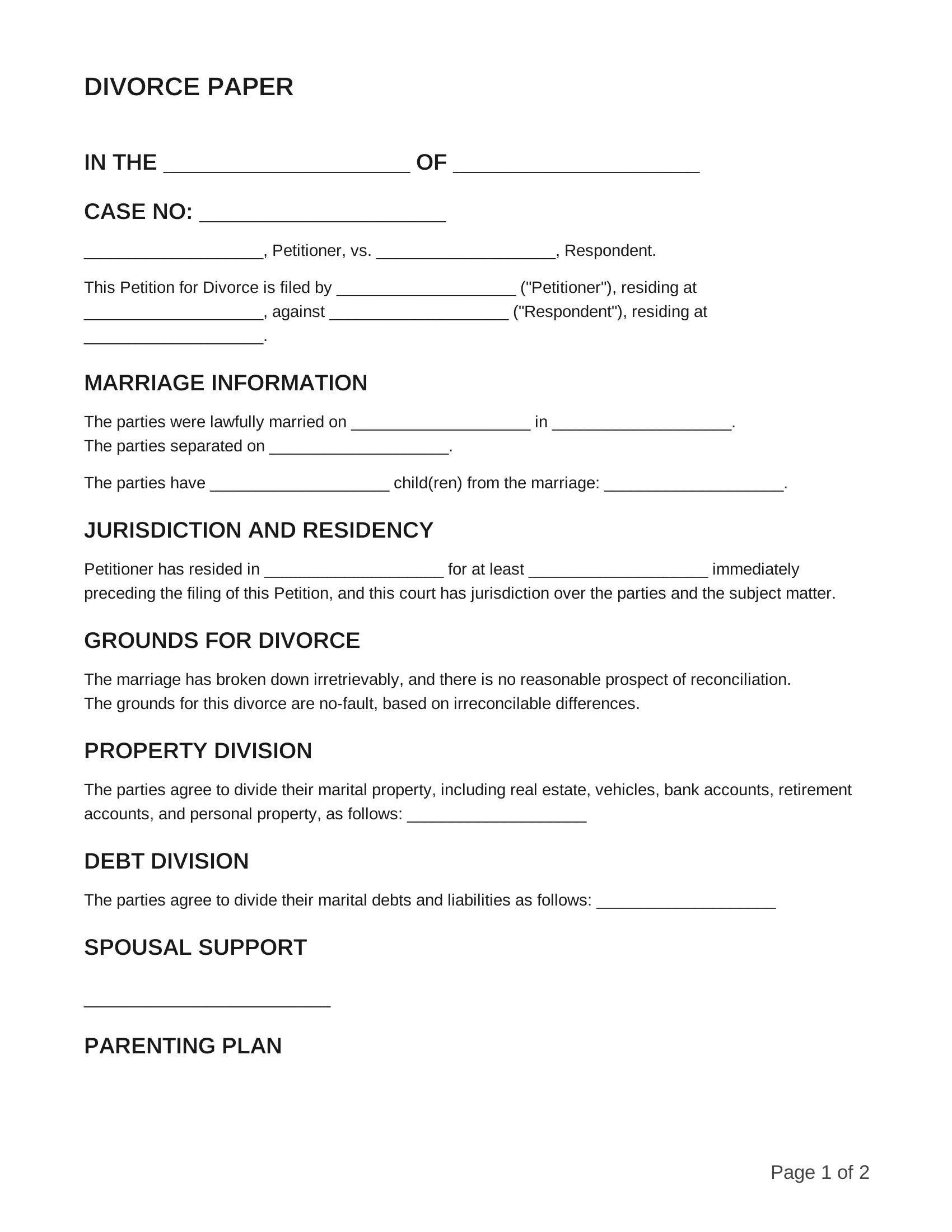
A divorce papers packet is the set of court documents you file to begin and end a divorce. The core documents are the same in most states: a Petition for Divorce that starts the case and states the grounds, a Summons that notifies your spouse and gives them a deadline to respond, and a Settlement Agreement that divides property, debt, and support. If children are involved, a Parenting Plan is added, and some courts also require a Financial Affidavit.
One thing worth knowing before you start: all 50 states now allow no-fault divorce, so you don't have to prove your spouse "did something wrong." Most petitions simply cite irreconcilable differences — a change that has made uncontested divorce dramatically simpler than it was a generation ago.
Every packet on this page is generated as a fillable Word document and a PDF, with plain-English instructions on each form — what to fill, what to sign, and what to notarize. Build your packet and the preview pane shows exactly what you're filing before you download.
Which divorce papers match your situation
The right packet depends on whether you and your spouse agree, and whether you have children. Four types cover the vast majority of cases: an uncontested divorce where both spouses agree on every term, a contested divorce where some terms are disputed, an uncontested divorce with children that adds a parenting plan, and a contested divorce with children that covers custody and the parenting plan together.
Pick the type that matches your situation in the generator and it builds only the sections you need — no irrelevant clauses, no blank pages to puzzle over.
Why state-specific divorce papers matter
Divorce is state law — residency requirements, waiting periods, filing fees, and even the required forms differ in every state. A handful of states mandate their own court paperwork, and where that applies, we link directly to the official packet on the state's page so you use the exact version your county expects.
Choose your state in the state list above to see the forms, filing fee, and waiting period that apply where you file.
What to gather before you start
Before you fill out anything, collect the details the forms ask for: your marriage certificate, the full legal names of both spouses, your assets and debts (accounts, property, vehicles), income figures, and — if you have children — their dates of birth and Social Security numbers.
Having these at hand makes the generator faster and keeps your divorce papers accurate. Courts send packets back when fields are missing or mismatched, so it's worth ten minutes of preparation before you begin.
How to get divorce papers — free and fast
You don't need a lawyer to obtain the forms. Nearly 90% of state court websites publish free, downloadable divorce forms organized by county and case type, and every template on this site is drafted for general U.S. use and updated for the current filing year.
Three practical details most guides skip: residency matters — you generally must have lived in the state for 6–12 months before filing; fees are real but modest, roughly $100–$450 depending on your county, with waivers available for low-income filers; and e-filing is now standard in most counties, which usually means faster processing than mailing paper.
What to do when you receive divorce papers
If your spouse has filed, don't ignore the papers. The Summons includes a deadline — usually 20 to 30 days — to file a response. Miss it, and the court can enter a default judgment, and you lose your chance to contest anything from assets to custody. Even if you intend to agree with everything, respond formally, then negotiate the agreement.
What if we can't agree on the terms?
If you and your spouse can't agree on property, debt, or custody, the divorce becomes contested — and that changes how it moves forward. The court sets deadlines for exchanging financial disclosures, and either spouse can request a hearing for the judge to decide the unresolved issues. Before that point, most courts require or strongly encourage mediation, where a neutral third party helps you reach an agreement outside the courtroom. Mediation is usually far cheaper and faster than a trial, and many couples who start out contested end up settling in mediation.
Your divorce papers checklist
- Confirm state residency requirements
- Gather your marriage certificate and financial records
- Choose your grounds — usually no-fault
- Fill every field carefully — errors get packets sent back
- Sign and notarize where required
- File with the county clerk and pay the fee
- Serve your spouse and keep proof of service
Sources we reference
- Official state court websites for petition packets, filing fees, and waiting periods — for example New York State Courts, California Courts, and Texas Courts.
- State bar associations and legal aid self-help portals, such as the ABA Family Legal Guide and Legal Services Corporation.
- Court self-help centers and e-filing guidance, including U.S. Courts and California Courts Self-Help.
Last full review: August 2026 · Reviewed by Sarah Brooks, Editor. How we verify content.